
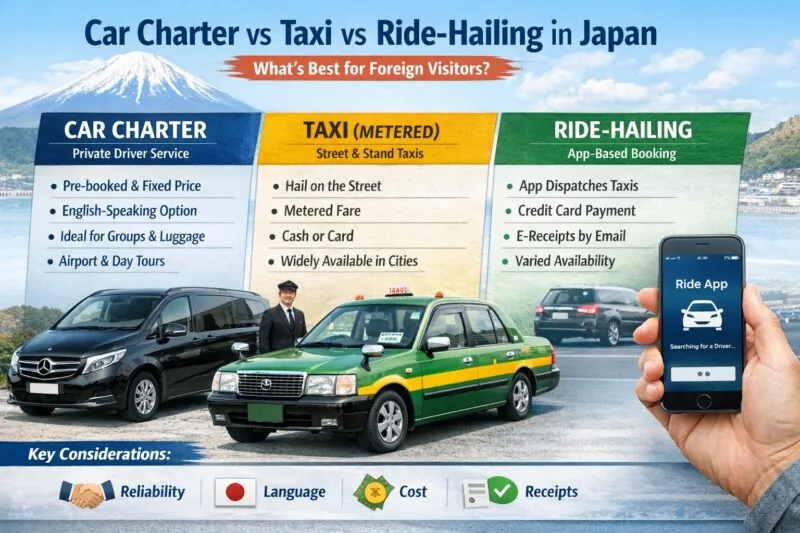
Japan is famously easy to travel around, but once you land with suitcases, kids, a tight schedule, or a business agenda, the “best” way to get from A to B isn’t always the train. Most foreign visitors end up deciding between three options for road travel: a private car charter with driver, a regular taxi, or a ride-hailing app. They all work in Japan, but they work differently than many travelers expect—especially when it comes to availability, language support, payment methods, and getting proper receipts.
This article walks through each option in real-world terms, so you can choose the most reliable and cost-effective solution for your trip.
Understanding the three options in Japan
A taxi in Japan is a licensed, metered vehicle that you can hail on the street, take from a taxi stand, or book through a hotel. Drivers are professional, the cars are typically clean, and the rules are strict. This is the most familiar option for short city trips.
Ride-hailing in Japan often looks like Uber or other global platforms, but in many Japanese cities the system commonly dispatches licensed taxis rather than private individuals driving personal cars. For foreigners, that means your “ride-hailing” trip can feel like a taxi ride—with the benefit of app booking and digital receipts—rather than the cheaper peer-to-peer model common elsewhere.
A car charter (private car with driver) is a pre-booked chauffeured service. You confirm the vehicle type, pickup time, and itinerary in advance. Pricing is typically either a fixed one-way transfer (for airport pickup or city-to-city travel) or hourly/full-day hire (for sightseeing and multi-stop schedules). It is the most structured option and usually the most comfortable, especially for groups and luggage.
Reliability: which option is most dependable?
If you care most about reliability, car charter generally ranks highest because it is arranged in advance and attached to a specific booking. A professional driver is assigned to you, your pickup time is agreed, and reputable operators will provide clear meeting instructions for airports, hotels, and stations. For travelers arriving after a long flight—especially families, older travelers, or first-time visitors—this predictability is often worth it.
Taxis are also very reliable in major cities like Tokyo, Osaka, and Kyoto, but “reliable” doesn’t always mean “available instantly.” During rush hours, heavy rain, late-night periods after the last trains, or big events, taxi demand spikes and you may need to wait. In tourist-heavy areas, you can also face lines at taxi stands.
Ride-hailing depends heavily on location and time. In areas where the app is effectively dispatching taxis, it may perform similarly to taxis—sometimes better because the app can find nearby vehicles without you standing outside. But in quieter neighborhoods or smaller cities, coverage can be weak, and “no cars available” is not unusual.
For rural areas, ski regions, and places with limited taxi supply, charter is typically the most dependable because it’s reserved rather than “requested.”
Price predictability: the hidden stress factor
For many foreigners, the most frustrating part of taxis is not the cost—it’s the unpredictability. Taxi fares are metered, so traffic, detours, and slow movement can make the final price higher than expected. If you’re going from one neighborhood to another inside the city, this is usually manageable. But if you’re going farther or traveling at a time when roads are crowded, the meter can climb quickly.
Ride-hailing can feel more predictable because the app may show an estimate and the route on a map. However, if the ride is actually a dispatched taxi, the fare can still be meter-based. In other words, the app helps you book and track, but it doesn’t always guarantee a fixed price.
Car charter is the most predictable option. Most operators quote you in advance based on the route or the hours booked, and you know what you are paying before the driver arrives. This is especially helpful when you have multiple stops, a full-day plan, or a business schedule where timing matters.
The key is to confirm what is included in the quote. A good charter quote will clearly state whether tolls, parking, fuel, and driver fees are included, and what happens if your schedule runs overtime.
Language support and “foreigner friendliness”
Japan is improving quickly with English signage and travel support, but language still matters when transportation plans change. Taxi drivers are professional and polite, but many are not fluent in English. For simple trips, that’s not a big issue if you show a map pin or the hotel’s address in Japanese. But for more complex situations—multiple stops, special pickup points, or schedule changes—communication can become difficult.
Ride-hailing apps reduce some language friction because you enter your destination in the app, drop a pickup pin, and everything is stored digitally. This can be especially useful around huge stations where it’s hard to explain which exit you’re at.
Car charter can be the most foreigner-friendly if you specifically book English support. Even if the driver’s English is basic, reputable charter providers often offer English customer service through WhatsApp/LINE and send clear pickup instructions. For many travelers, that “support layer” makes a major difference.
Payment in Japan: cash, cards, and what to expect
Payment is one of the biggest practical differences for tourists.
Taxis often accept cash everywhere, and many accept credit cards, but not all. In big cities, card acceptance is common, but you should still check for card stickers on the window or ask before departing if you must pay by card. It’s wise to carry cash as backup.
Ride-hailing is usually the easiest for cashless payment because your card is connected in the app. If your ride is dispatched through a taxi network, the app handles payment and you step out without worrying about whether the car has a card terminal.
Car charter is typically paid online in advance by card or by invoice arrangements (especially for corporate travelers). This is convenient for foreigners because it removes the “do I have enough cash” problem, and it reduces end-of-trip friction.
Receipts: what business travelers and reimbursements require
If you need receipts for expense claims, Japan is generally good—but the format differs.
Taxis can print receipts, and many drivers will offer them automatically. If not, you can ask for one. Receipts may be in Japanese and show the taxi company, time, and fare. If you’re filing business expenses, keep them organized and consider photographing them as backup.
Ride-hailing is usually the easiest because receipts are digital. They are typically emailed automatically, and you can re-download them later. For many business travelers, this alone makes ride-hailing preferable for short city trips.
Car charter often provides the most formal paperwork. Reputable companies can issue an invoice or receipt with company name, service date, route/hours, and total amount paid. If you need your company name on the invoice, it’s usually possible—just request it when booking.
Luggage, group size, and comfort: where charter wins

For solo travelers or couples with light luggage, taxis are simple and convenient. But once you add large suitcases, strollers, ski bags, or a group of 3–6 people, the equation changes fast. Standard taxis have limited trunk space, and you may end up splitting into multiple cars—which increases cost and reduces coordination.
Ride-hailing doesn’t automatically solve this because it often dispatches standard taxis unless you can choose a larger vehicle category.
Car charter is designed for this scenario. You can book the correct vehicle size—sedan, premium van, or minibus—and confirm luggage capacity in advance. This is one of the most practical reasons foreigners choose charter in Japan.
Real-world recommendations: what to book for common situations
If you’re arriving at the airport with luggage and want a smooth start, car charter is usually the least stressful. You know who is picking you up, where to meet, and what the price is. If you’re traveling light and your hotel is in a central location, a taxi is perfectly fine. Ride-hailing is also good if you prefer cashless payment and a digital receipt, especially in major cities.
If you’re doing a full day in Kyoto, Hakone, Mt. Fuji area, Nikko, or any itinerary with multiple stops, charter is often the most efficient option. You avoid repeatedly finding taxis, explaining destinations, and dealing with the meter at each leg. For a quick restaurant-to-hotel ride at night, taxi or ride-hailing is the simplest.
If you’re traveling in rural areas, heading to ski resorts, or moving with a strict schedule, charter usually offers the highest reliability. Taxis can be scarce outside city centers, and ride-hailing coverage may be inconsistent.
The bottom line
In Japan, taxis are safe and convenient for short, simple trips, but they can become expensive and unpredictable for longer distances or heavy traffic. Ride-hailing is often a smoother way to access taxis—especially for cashless payment and digital receipts—though availability still varies by city and time. Car charter is the premium option: it costs more, but it delivers the highest predictability, the best luggage and group handling, and the most reliable experience for airport pickups, multi-stop sightseeing, and business schedules.